
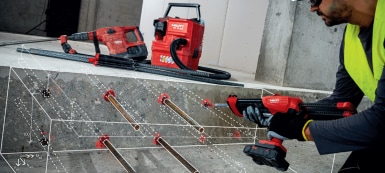
The American Concrete Institute (ACI) standard titled Building Code Requirements for Structural Concrete (ACI 318) provisions for “shear friction” consider an interface between two concrete surfaces over which shear acts. The design premise is that developing the yield strength of a reinforcing bar on each side of the interface will clamp the two concrete surfaces together, thereby resisting the applied shear acting on the interface. In reality, yielding the bars on one or both sides of the interface, such as assumed when using the ACI 318 shear friction method, is difficult to achieve. However, a shear friction design alternative not predicated on bar development is now possible.
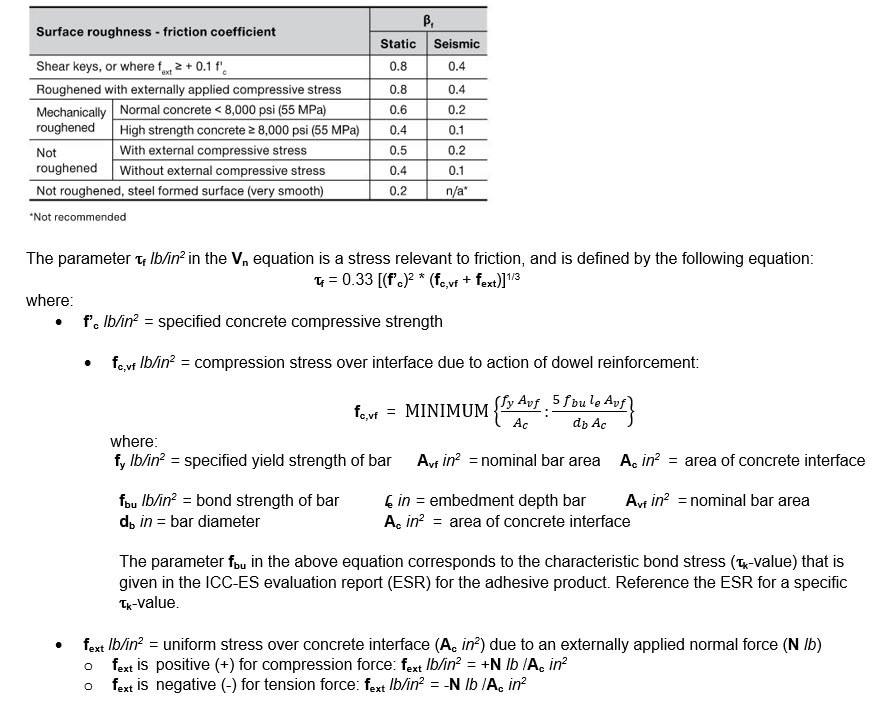
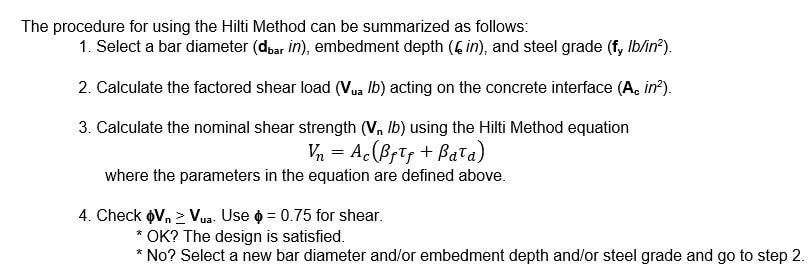
Hilti has utilized Palieraki et al. (1) research that considers a calculated resistance between two concrete surfaces over which shear acts and is not predicated on bar development. Instead, the shear friction resistance at the interface between concrete surfaces and resistance due to dowel action on the reinforcing bars are calculated to give an overall shear resistance. This resistance is checked against the applied shear acting on the interface. The advantage of this method is that a shallower bar embedment not predicated on development (i.e., bar yielding) on each side of the interface can be obtained while still providing a design solution for resisting the applied shear. This design concept will be referred to as the “Hilti Method.”


Summary
Shear friction design predicated on a reinforcing bar yielding on both sides of a concrete interface is difficult to achieve. The Hilti Method is a shear friction design alternative for post-installed reinforcing bars that are not predicated on bar yielding. Instead, a design strength that considers the resistance due to friction at the concrete interface and the resistance due to dowel action on the reinforcing bar(s) is calculated and checked against a factored shear load. The advantage of this method is that a shallower bar embedment not predicated on bar yielding can be obtained while still providing a design solution for resisting the applied shear acting over the concrete interface.
