
ENVIRONMENTAL PRODUCT DECLARATIONS AND LIFE CYCLE ASSESSMENTS IN PASSIVE FIRE PROTECTION.
Environmental Product Declarations (EPDs) and Life Cycle Assessments (LCAs) are tools used to measure and communicate the environmental impact of construction products. They help project teams achieve sustainability goals, calculate embodied carbon, and support green building certification schemes such as LEED, BREEAM, and DGNB.
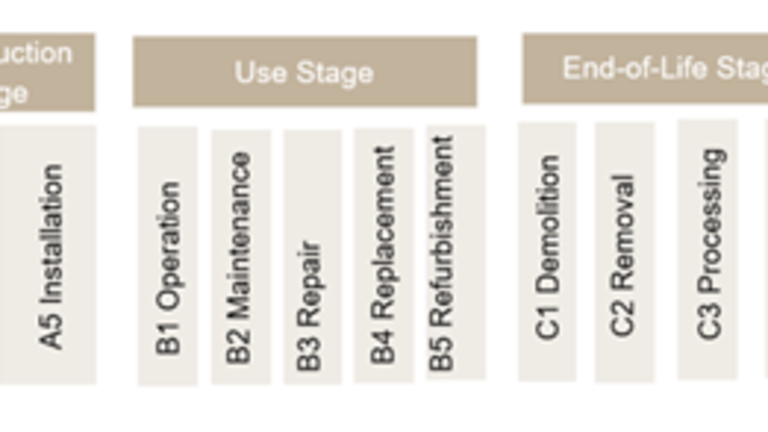
Environmental Product Declarations
Environmental Product Declarations set out the environmental impact of a product from Raw Material and Manufacturing to Removal from the Building to Product End of Life. (see figure 1 above). The calculation is based on real energy data from the factory and is third party verified by an external verifier. The environmental impact is calculated based on kg equivalents of CO2 Emissions/kg product. The assessment from Cradle to Grave is called a Life Cycle Assessment and considers all aspects related to the product manufacturing, use and end of life, including raw material impact, manufacturing energy, manufacturing and product waste, transport to the jobsite, removal from the building and end of life scenarios such as recycling, incineration with / without energy recovery or landfill. It also provides information on how and where the product is manufactured, if recycled / recyclable or biogenic (e.g. biobased, wood) materials are included and if the product contains REACH restricted / Substances of Very High Concern.
In passive fire protection, generally the biggest contributing factor is raw material extraction and chemical manufacture. The in-use phase generally has a negligible impact, since once the product is assembled in the building it will stay there until the building end-of-life. The end-of-life scenario depends on the product type, how easy it is to remove from the building and recyclability.
The CO2 footprint is calculated based on 1kg of product. This information enables calculation of the total CO2 footprint product used in the application or to simply have an indication of the environmental impact of the product.
There are many other environmental indicators covered in EPDs which can give insights into how the product impacts the environment. The CO2 value provides an overarching indicator of the product’s environmental impact.
Life Cycle Assessments
Life Cycle Assessments also set out the environmental impact of a product from Raw Material to end of life however are generally based on average energy data from the factory and provide the results for 1 unit of product as sold. They are not third party verified however still provide an insight into the Carbon Footprint of a product.
EPDs, LCAs and Green Building Schemes.
Green Building Schemes such as LEED, DGNB and BREEAM have specific criteria for materials and the Life Cycle Impact of Buildings. Whole buildings or projects are certified based on detailed criteria in those Green Building Schemes. Table 1 shows examples of Green Building Schemes and the credit categories where EPDs can support the achievement of points. If a project is certified under any of these schemes, a product level 3rd party verified EPD can be a big help in achievement of credits towards the overall Building Certification. In LEED certified projects, critically reviewed LCAs can also contribute to credits however have a lower credit contribution compared with third party verified EPDs.
EPDs, LCAs and Project Sustainability Goals
If your project has specific goals for CO2, a Product EPD and an LCA provides the data transparency needed on the CO2 impact of the Firestopping used in the application with the differences in data outlined above.

Table 1: Green Building Scheme and Credit Category with Environmental Product Declarations Relevance.

Hilti Sustainability Strategy and SBTi
To support Climate Goals and Reduce Global CO2 Emissions due to the built environment, Hilti has set ambitious reduction targets until 2032 validated by the Science Based Targets Initiative with the long-term goal to achieve net-zero Emissions by 2050. One main contribution to achieve that is making products more Sustainable.
Hilti’s ambition is to become our customer’s Best Partner for Sustainability both through the solutions we offer and how we operate and is based on the 3 strategic pillars of Environment, People and Society. The Environment Pillar includes Decarbonisation of own operations, more sustainable products and more sustainable construction. EPDs, providing third party verified Data Transparency on CO2, are a key part of this Strategy.
Hilti Passive Fire protection
Today, Hilti Firestop Products can support Hilti Customers and Building Owners in the selection of Supplied Products with the provision of Environmental Product Declarations and critically reviewed LCAs. These are available for several different pre-formed and wet applied products including Speed Sleeves, Blocks/Plugs, Cast-In Devices, Firestop Foams, Steel Coatings, Adhesives and Sealants and Cavity Barriers.
Beyond firestop, Hilti offers over 50 EPDs covering over 1000 items including anchors and MEP supports.
EPD_Summary and Conclusions
Both LCAs and EPDs Provide Data Transparency on Product Carbon Footprint – kgCO2e / kg product, Information on the product, the manufacturing process and location aswell as raw materials used and in doing so help achieve credits in Green Building Schemes.
The main difference between the two is use of real plant data collected over 1 calendar year (EPDs) versus generic data (LCAs).
In addition, EPDs are generally third party verified whereas LCAs are not.
They support Construction Projects on the assessment and achievement of sustainability goals and enable calculation of the whole building / project CO2 footprint, provide transparency on other environmental impact categories such as Ozone Depletion Potential, Water Use, Depletion potential of the stratospheric ozone layer (ODP), water usage and Eutrophication Potential and with Third Party Verification, the calculation and data has been critically reviewed and verified by an external assessor.
To access all EPDs available, check Hilti Online on the product page under Sustainability.
EPD_REFERENCES
References:
LEED 5.0 Building Design and Construction
April 2025, Launch Edition
LEED V4.1 Building Design and Construction
October 2021
BREEAM-NOR v6.0 New Construction Technical Manual SD5076NOR
BREEAM International New Construction Version 6.0
Technical Manual-SD 250
DGNB System
Kriterienkatalog Gebäude Neubau
Version 2018
Financing Transformation
A Guide to Green Building for Green Bonds and Green Loans
2024
Alliance HQE
Bre
Green Building Council Australia
Singapore Green Building Council
U.S. Green Building Council USGBC
Hilti Sustainability Strategy:
www.hilti.group/content/hilti/CP/XX/en/company/Sustainability/Sustainability.html