
HILTI HAC-C-T SERRATED ANCHOR CHANNELS TO ACHIEVE HIGHER PERFORMING DESIGN WITH MORE PEACE OF MIND
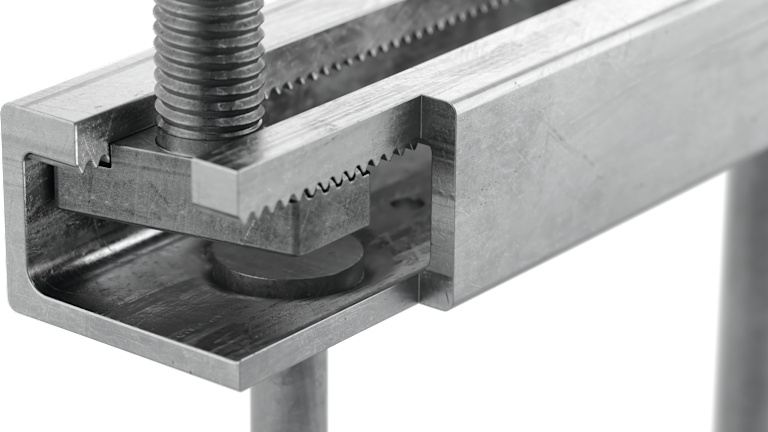
Hilti introduced its latest innovation in Cast-In Anchor Channel HAC-C-T Serrated to address the growing demand for higher-performance fastening solutions in concrete structures, particularly where smooth anchor channels fall short in static and seismic loading resistance. The innovative serrations on the channel lips create a mechanical interlock with matching T-bolts, enabling superior resistance to high forces parallel to the channel axis for diverse designs.
One Serrated Channel - Multiple Applications
1. WHAT ARE CAST-IN CHANNELS?
Anchor channel systems can be a cost-effective fastening solution embedded in concrete. The technology provides a solution for jobsite tolerances and on-site adjustability when connecting
structural and non-structural elements.
The system consists of a group of anchors connected to a channel profile (anchor channel) and an appropriately matching channel bolt (t-bolt). The anchor channel is installed in formwork prior to the concrete casting. The channel profile comes with a filler foam to keep the inner channel profiles and channel lips protected from concrete contamination. After concrete hardening, the filler foam should be removed. This leaves the channel profile open and ready for the installation of the t-bolt. After inserting the t-bolts into the part to be fastened, the t-bolts are completed by washers and nuts and then tightened down applying the required installation torque to create a pre-tension in the system.
-

Compared to traditional welded cast-in embed plates, anchor channel systems provide more flexibility and avoidance of welding on site.
Moreover, anchor channels can reduce the installation time per connection vs. post-installed solutions as drilling is avoided, allowing to improve the productivity of the installer. They also may increase the structural reliability of the connection. (For additional anchor channel applications, see chapter 4)
By eliminating the need for post-installed anchors or welding, cast-in channels can:
Enhance structural integrity — no drilling into hardened concrete, avoiding hitting or damage rebar or concrete spalling
Speed-up installation — Position of t-bolts can be adjusted and repositioned within channel profile
Provide flexibility — allow late-stage alignment changes after structure curing
Cast-in channels are common practice in many projects and applications in sectors such as Curtain Wall Façades, Civil structures, Infrastructure, Mechanical and Electrical Installations and Industrial production facilities.
2. INNOVATION IN ANCHOR CHANNELS – HAC-C-T SERRATED
The HAC-C-T serrated anchor channel system builds on the established foundation of Hilti HAC-C and HAC-C-P hot rolled channels and offers performance and efficiency. Hilti Anchor Channel systems with serrated channel lips (HAC-C-T) and matching serrated t-bolts is a cast-in solution for applications that require on-site adjustability and resistance in the longitudinal direction of the anchor channel as those can result from shear loads such as seismic, wind, live loads, gravity or others.

Fig. 2.1: Serration of the HAC-C-T anchor channels in the longitudinal direction and compatible T-bolts
The European Technical Assessment for Hilti HAC-C-T anchor channel systems, ETA-17/0336 (Aug. 29th, 2025) [1], refers to EN 1992-4 [2] for design against 2D (tension, perpendicular shear) static and fire exposure according to ISO fire curve, EOTA TR047 [3] for the case of seismic loading, CEN/TR 17080 [7] for longitudinal shear loading, and to EOTA TR 050 [4] for the fatigue loading.
The growing demand in a cast in anchor channel solution that can offer higher efficiency, adjustability over the lifetime of a structure and address 3rd direction loading on anchor channels for structural and non-structural applications require a versatile serrated anchor channel system. Accordingly, a new development of hot rolled anchor channels was carried out and the new high performing Hilti HAC-C-T serrated anchor channel portfolio is being launched.
Before going into details of the new solution, that are described in the Chapter 5, the main advantages and key application areas are presented in the following Chapters 3 and 4.
3. CUSTOMER BENEFITS OF USING HAC-C-T AND RELATED SPEC2SITE OFFERINGS
HAC-C-T serrated anchor channels come with a complete offering from Specification to Jobsite (SPEC2SITE) which includes the design integrated in PROFIS Engineering software based on latest assessment data as per ETA-17/0336, technical product documentation in the Hilti Engineering Center and the offer of personal support extended from office to jobsite by the local Hilti sales and engineering team. When structural engineers use HAC-C-T SPEC2SITE offerings in their application, it helps them to design better specifications (Table 3.1).
Table 3.1: HAC-C-T SPEC2SITE offering helps customers design better specifications; higher performing, value engineered and more sustainable with more peace of mind.

4. KEY APPLICATIONS OF HAC-C-T ANCHOR CHANNELS
HILTI HAC-C-T anchor channel system is suitable for a variety of demanding structural and non-structural applications under static (2D and 3D) and dynamic (seismic, fatigue) loading, as well as fire exposure in cracked and uncracked concrete. Some of the key applications are as follows (Fig. 4.1):

Fig. 4.1: Different applications for HAC-C-T anchor channels
This “one system, many applications” capability delivers enormous value by simplifying designs, reducing complexity at the jobsite, simplifying procurement, and enabling engineers to specify a single high-performance solution.
5. APPROVALS FOR HAC-C-T ANCHOR CHANNELS
HAC-C-T anchor channels are covered by the European Technical Assessment (see 1) that covers the use of channel in cracked / uncracked concrete under static, quasi-static 2D and 3D, seismic and fatigue loading and fire exposure. It also has an Expert’s report for tunnel applications where the fire resistance is relevant.
Table 5.1: European Technical Assessment and Technical Reports available for HAC-C-T anchor channel systems:

6. NEW FEATURES AND BENEFITS
6.1 Multiple profiles and material type
HAC-C-T with serrated channel lips are offered in an array of four channel profile sizes: HAC-C-T 29/20, HAC-C-T 40/22, HAC-C-T 50/30, and HAC-C-T 53/34 allowing wide application coverage. Apart from these sizes with standard embedment depth there are two additional versions HAC-C-T 40L and HAC-C-T 50L which feature the same channel profile (as 40/22 and 50/30) but with longer anchors to help increase concrete resistances where those might become relevant for designs. HAC-C-T is available in Hot dip galvanized (HDG) and Stainless Steel A4 for addressing various needs for corrosion protection.

Fig 6.1- HAC C T portfolio
6.2 Working principle
The serrated interface between the channel and t-bolt significantly increases resistance to longitudinal shear forces, outperforming both smooth HAC-C and V-shaped channels of the Hilti portfolio.
The innovative manufacturing technology allows HAC-C-T to offer longitudinal shear resistances that require up to 50 percent lower installation torques than existing technologies while offering high performance of the anchorage at the same time. Because of the lower installation torque, the installation time per connection can be reduced and muscle fatigue may be avoided.

6.3 Universal T-bolt
Portfolio of Hilti channel bolts (HBC-T) includes 3 different configurations that are compatible with different channel types. Depending on the t-bolt configuration, different diameters are available, and overall portfolio includes sizes M10, M12, M16, and M20 with bolts being offered in two different materials versions: Carbon steel with a strength class 8.8 with hot-dip galvanized (HDG or F) coating, and Stainless-steel grade A4-70.
Table 6.1- Compatibility of Hilti Serrated Channel Bolts (HBC-T) with Hilti anchor channels


Fig 6.3- Hilti Serrated Channel Bolt (HBC-T)
HBC-T can be used to transfer tensile loads, perpendicular and longitudinal shear loads, and or any combination of these loads. Transferring of the longitudinal shear loads take place via interlock of the serrations of the HBC-T t-bolt with the serrated lips of HAC-C-T anchor channels.
A directional head marking on the t-bolt aid the installer to ensure the bolt is properly positioned perpendicular to the channel profile before the installation torque is applied. Moreover, the head marking allows the installer and inspector to identify the position of bolt after the fixture is installed.
6.4 Extended design life of 100 years
In addition to the standard assumed working life of 50 years as per the intended use as per the European Assessment Document EAD 330008-04-0601, which is valid for both – Carbon steel and Stainless-steel elements, the newly updated ETA-17/0336 for the HAC-C-T covers as well the assumed working life of 100 years for the elements made of Stainless steel A4.
6.5 Expert’s report for the Tunnel applications
In addition to the European Technical Assessment, that covers the information related to the Fire resistance of the product in case of a standard ISO-834 fire curve, an additional Expert’s report (ZTV-ING Tunnel fire) for fire resistance in Tunnel applications was issued [5].
6.6 Design Software
HAC-C-T channels with HBC-T bolts are integrated in HILTI’s PROFIS Engineering software, which allows users to quickly and accurately design anchor channel systems. Through a simple, user-friendly interface, PROFIS Engineering helps to design anchor channel fastenings under static, seismic, fatigue loads and/or fire exposure, according to the latest available building codes, approvals, and standards.
7. INSTALLATION FEATURES THAT SIMPLIFY LIFE ON JOBSITE
Pre-punched nail holes in channel profile: Quick, accurate fixing to formwork.
Plastic endcaps with nail-holes and centring line: Accurate centred positioning of channel. Nailing to the formwork with nails in position to allow full movement of t-bolt along the length of channel. Positioning stops for t-bolt to ensure fastening within allowable limits inside of the most outer anchors.
Closed-cell foam filler: Reduces contamination of the channel lips and serrations from concrete.
Adjustable t-bolts: Slide and reposition post-pour for error correction.
Reduced Torque: Less installer effort, faster execution.
Durability Options: Surface coating and/or stainless steel for different environmental requirements.

For more details regarding products and installation steps refer to relevant IFU for HAC-C-T anchor channel: Put link of respective IFUs from HOL.
8. CONCLUSION
8. CONCLUSION
With HAC-C-T, customers can simplify anchor channel selection without compromising on strength, safety, or sustainability. Whether you’re working on high-rise façades, demanding infrastructure, precision mechanical installations and piping, or industrial manufacturing applications, HAC-C-T is one single serrated channel system offering a solution to many design challenges.
“HAC-C-T: One Serrated Channel, Multiple Applications.”
Please visit HOL page for more details on the anchor channel
9. REFERENCES
ETA-17/0336: Hilti HAC-C-T , DIBT, Germany, XX.XX.2025
EN 1992-4:2018: Eurocode 2 - Design of concrete structures - Part 4: Design of fastenings for use in concrete
EOTA TR 047, Design of anchor channels in addition to EN 1992-4, amended May 2021
EOTA TR 050, Calculation method for the performance of Anchor channels under Fatigue Cyclic Loading", amended October 2023
Advisory Opinion No. GS 6.1/24-043-3 (ZTV-ING Tunnel fire), MFPA, Germany, 17.06.2025
Anchor Channel Product Guide , Edition 1, Schaan: Hilti Corporation, 2019.
CEN/TR 17080:2018 Design of fastenings for use in concrete - Anchor Channels - Supplementary rules
To explore more engineering topics, please visit and register with our Engineering Center!