
WATER RESISTANCE: WHAT IS A W-RATING?
What is a W-rating—and why does it matter? Discover how W-rated firestop systems help protect buildings from water damage after sprinkler activation or pipe failures. Learn what the UL W-rating measures, where it matters most, and why it’s becoming an important factor in resilient, high-performance building design.
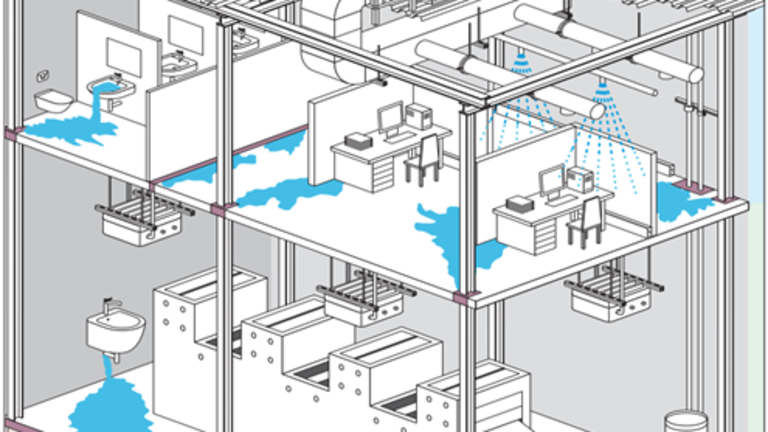
What is a W-Rating?
A W-rating refers to a firestop system’s ability to resist water passage through a floor assembly. In August 2004, UL established a procedure to quantifiably measure a firestop product’s water resistance in buildings. To qualify as a class 1 W-rated system, the firestop assembly must withstand a 3ft head of water for 72 hours with no leakage. This test simulates short-term water exposure, such as from a burst pipe or accidental sprinkler discharge. The W-rating does not necessarily guarantee long-term water resistance. Over extended periods, even W-rated systems may not prevent water penetration, especially if exposed to continuous or severe water conditions. This new optional W-rating for water resistance joins UL’s other optional measure, the L-rating for air leakage, and the two required measures, F- and T-ratings. These UL W-Ratings are directly connected to the fire tests. They can be found in the UL directory.
While firestop systems are installed as a passive fire containment mechanism, sprinkler systems serve as active fire containment. Once triggered, sprinkler systems reduce the heat source by directly cooling the fire flames as well as dampening the fuel source by moistening the flammable materials feeding the fire. However, in the process of containing the fire the water source often does a great deal of damage to the remaining building structure by subsequently flowing through penetrations to the floors below. Hilti has approached this problem by developing a versatile line of products and systems that have successfully been tested to the class 1 W-rating requirements.
W-rated firestop systems are incredibly important in places where water resistance is a must like in data centers, hospitals, commercial buildings and industrial facilities to safeguard sensitive data in electronic equipment, critical medical equipment vital for patient care, continuity of business operations and production lines from water exposure.
Not all water-repellent sealants/products are W-rated. So, these products were subjected to the standard 3-ft water column pressure test for 72 hours followed by a fire and hose stream test in accordance with UL 1479. The class 1 W-rating is listed on a variety of Hilti firestop systems covering the following penetrating material types:
Bare metallic pipes, conduits or tubing
Cable bundles
Insulated metallic pipes or tubing
Multiple or mixed penetrants
Non-metallic pipes, conduits or tubing
Sheet metal ducts
Presently, the test protocol for W-rating as per UL 1479 does not include:
Movement
Aging
Washout/rain resistance
Heads greater than 3ft
Test setup for W-rating
A block of concrete is cast with a centered, square opening. The dimensions of the block are 40 cm × 40 cm × 10 cm. The dimensions of the opening are 18 cm × 18 cm. The opening is sealed with the firestop product, in accordance with the firestop approval regulations.

Figure 2: Sealed opening on a testing block
A Plexiglas tube with an internal diameter of 29 cm is then fastened to the concrete block. The seal between the concrete and the aluminum flange holding the Plexiglas tube is provided by a firestop sealant. The Plexiglas tube is then filled with colored water and checked daily for leakage.

Figure 3: Plexiglas on testing specimen
The results and their interpretation
The test is considered failed if water leaks through the firestop system. Slight traces of dampness, especially on the concrete, do not indicate failure. This test is not suitable for the purpose of verification of the general water resistance of Hilti firestop systems, as is required, for example, for service entries in exterior walls. Interpolation of the results to higher pressures or longer testing times is also not permissible.

Figure 4 Plexiglas filled with Colored water
Conclusion
While W-ratings are not mandated by code requirements, they are often noted by architects and engineers in specifications and requested by building owners who understand the importance of protecting their properties from water damage. Protect your multi-story project by adding W-rated products and firestop systems to your designs today!
Explore Hilti’s products and expertise—register today on the Hilti Engineering Center to get full access.
References